Systems
Books Banned for Exposing How Power Controls Society
28 May 2026·6 min read
Some books were suppressed not for what they said, but for how accurately they described the machinery of control around them.
Throughout history, books have been banned, censored or heavily challenged by governments, regimes and institutions because they revealed uncomfortable truths about how power controls societies, governments, media, history, human behaviour and independent thought. The works below explore propaganda, surveillance, psychological conditioning, elite manipulation, totalitarianism, and the way revolutions and political ideals get corrupted from the inside.
Unlike many recent school-library challenges, which tend to involve explicit content, these books usually faced targeted suppression for ideological or political reasons. The strongest of them are dystopian novels and nonfiction exposés that came uncomfortably close to describing real methods of control.
Fiction that named the machinery
1. 1984, George Orwell (1949)
1984 depicts a totalitarian regime built on constant surveillance, Big Brother, rewritten history, propaganda, Newspeak, doublethink and thought control. It shows how a government can manipulate truth, language, memory and reality itself in order to dominate a society.
Who controls the past controls the future. Who controls the present controls the past.
It was banned or restricted in the Soviet Union until 1988, and in North Korea, China and other authoritarian states. It has also been challenged in some American schools for its anti-government themes. Many regimes recognised the book as a fairly direct reflection of their own tactics.
2. Animal Farm, George Orwell (1945)
A satirical allegory of how a revolution built on equality turns into a dictatorship. It follows leaders who rewrite the rules, manipulate language, lean on propaganda, betray the population and consolidate power, and while it targets Stalinism directly, the warning it carries is much broader.
All animals are equal, but some animals are more equal than others.
It was banned or suppressed in the Soviet Union, Cuba, Kenya, the United Arab Emirates and China, and challenged in the United States for allegedly being communist or encouraging revolt. The CIA funded an animated adaptation and altered its ending for propaganda purposes.
3. Brave New World, Aldous Huxley (1932)
Huxley portrays an apparently perfect society held together by genetic engineering, a caste system, psychological conditioning from birth, consumerism, drugs and the elimination of family and individuality. The fictional drug soma keeps everyone comfortable, distracted and compliant. Where Orwell imagined control through fear and punishment, Huxley imagined control through pleasure and engineered happiness, which has aged in an uncomfortable direction.
It was banned in Ireland and Australia in 1932 and in India in 1967, and continues to be challenged in American schools and libraries over language, sexual content and its treatment of family and religion. Authoritarian systems disliked it for a different reason: its criticism of manufactured contentment and the loss of individual freedom.
4. Fahrenheit 451, Ray Bradbury (1953)
Firemen burn books to keep society comfortable, distracted and ignorant. The novel works through censorship, mass-media distraction, government control over ideas, the destruction of cultural memory and the slow decline of critical thinking, and it argues that a society cut off from knowledge becomes far easier to manipulate.
It has been challenged or banned in American schools for profanity, rebellious themes and anti-government ideas. The irony is unavoidable: a book about censorship, censored.
Nonfiction and political works
5. The Gulag Archipelago, Aleksandr Solzhenitsyn (1973)
A nonfiction account of Soviet forced-labour camps, Stalinist terror, propaganda and the systemic oppression of millions. Through eyewitness testimony it shows how totalitarian governments crush dissent, control information, use fear as a political instrument, rewrite history and normalise institutional brutality.
It was banned in the Soviet Union and had to be smuggled out of the country. Its publication contributed to Solzhenitsyn's exile, and it was heavily suppressed across communist states.
6. Doctor Zhivago, Boris Pasternak (1957)
A criticism of the Soviet Revolution's betrayal of its own founding ideals, showing how a political system takes hold of personal relationships, individual freedom, historical narrative and public truth. It was banned in the Soviet Union, and Pasternak faced intense persecution, particularly after he received the Nobel Prize in Literature.
7. The Protocols of the Elders of Zion (early 1900s)
This one belongs on the list for the opposite reason to the others. It is a fabricated document claiming to reveal a Jewish plan for global domination through finance, media and politics, and it is a widely debunked antisemitic forgery rather than any kind of exposé.
Despite being false it became influential in conspiracy and extremist circles, was distributed by prominent figures including Henry Ford, and was used by regimes to justify persecution and social control. It has been banned or restricted in many places because of its antisemitism, its hate speech and its history of encouraging persecution. Its significance lies entirely in what it demonstrates: how a fabricated narrative can be weaponised against an entire population.
8. The CIA and the Cult of Intelligence, Victor Marchetti and John D. Marks (1974)
An exposé of CIA operations, covert activities, intelligence failures, government secrecy and institutional manipulation. American courts required hundreds of passages to be removed before it could be published.
9. Spycatcher, Peter Wright (1987)
Written by a former MI5 officer, Spycatcher covers British intelligence scandals, surveillance activities and alleged plots to undermine governments. The British government tried to ban it internationally, failed, and in the process turned it into a bestseller.
Books about secret societies and elite control
A separate category claims that secret societies, powerful families or organisations such as the Illuminati control banks, governments, media and world events. These are rarely banned outright in democratic countries because of free-speech protections, though some have run into publisher rejection, distribution problems, event restrictions and bans in particular countries.
The examples usually cited are the works of David Icke, including The Robots' Rebellion and And the Truth Shall Set You Free, which claim that reptilian elites and hidden global forces manipulate society, and which have seen him banned from some countries and dropped by publishers; Bloodlines of the Illuminati by Fritz Springmeier, which claims thirteen families secretly run the world through occult networks; and The Illuminati: The Secret Society That Hijacked the World by Jim Marrs. These books mix documented fact with speculation and unproven theory, and several have been criticised for spreading misinformation and antisemitic ideas.
Why authorities ban books
Suppression tends to follow the same logic wherever it appears. Authorities move against books that encourage readers to question official narratives, recognise propaganda when they meet it, examine political systems, challenge the accepted version of history, identify methods of surveillance and manipulation, and generally think for themselves about power.
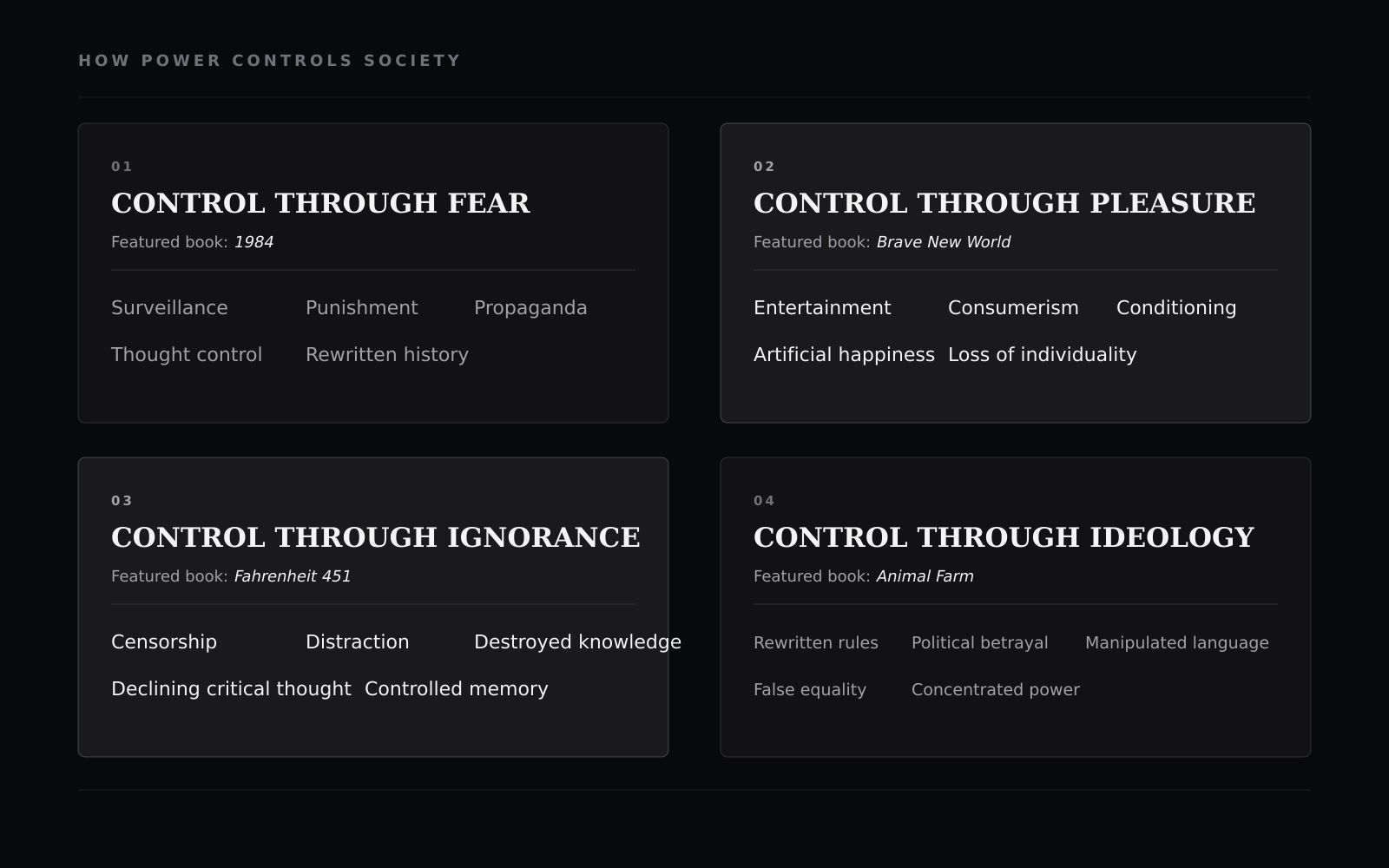
Fiction by Orwell, Huxley and Bradbury does this particularly well, because it takes abstract systems of control and makes them feel immediate and personal. It is worth noticing that many of these books were suppressed by exactly the kinds of systems they were describing.
A necessary distinction
Not every controversial book has genuinely been banned. Conspiracy books are rarely prohibited in democratic countries today and remain widely available online, and contemporary school-book challenges in the United States tend to focus on race, gender, sexuality and explicit content rather than on these classic political works. For current information on bans and challenges, the reports published by PEN America and the American Library Association are the place to look.
The most dangerous book is not always the one that gives you answers. Sometimes it is the one that teaches you to question the answers you were given.